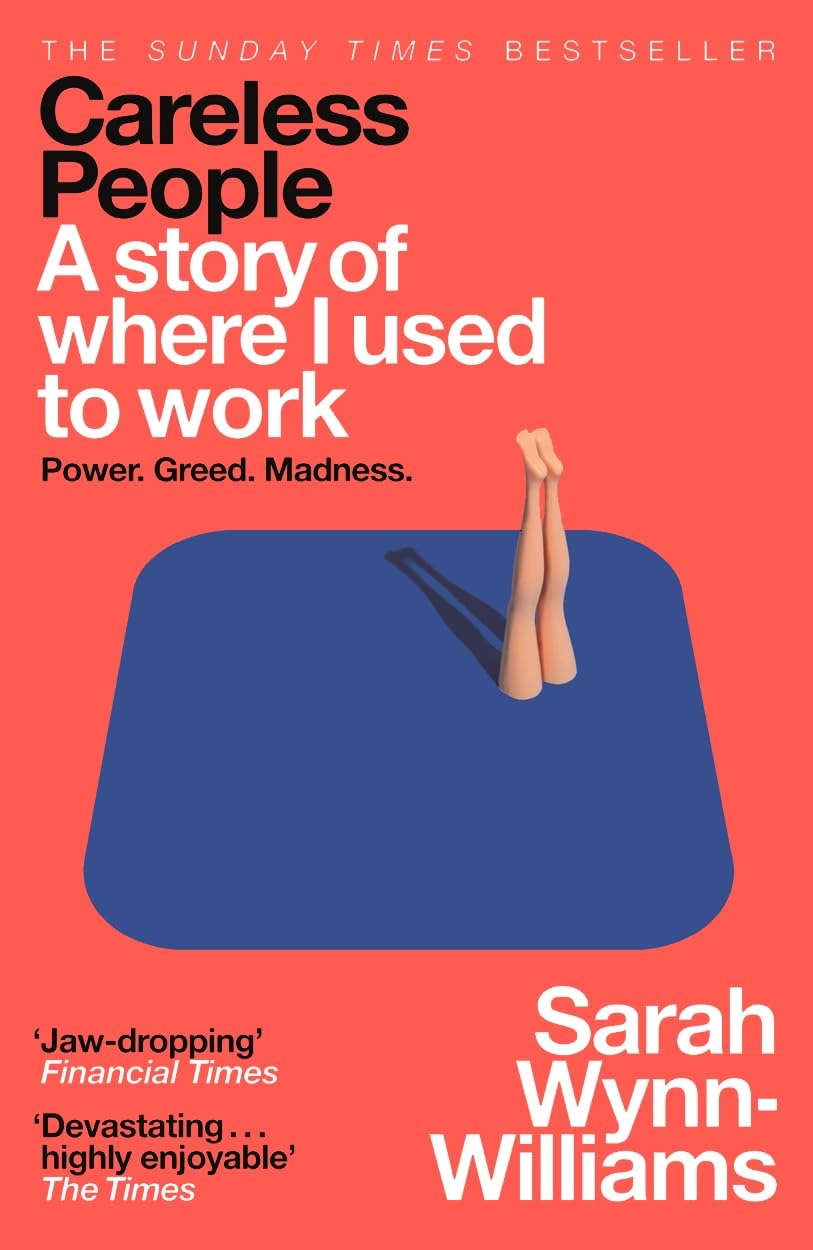
Careless People Careless People
Избранные цитаты из книги «Careless People» — Sarah Wynn-Williams. Selected quotes from Sarah Wynn-Williams's book "Careless People".
“Hello, Prime Minister Harper,” I say. “I’m Sarah Wynn-Williams from Facebook. You’ll remember me from all the data center and privacy stuff.” Look, it’s not a great start but it’s all I’ve got, and yes, “remember me” is definitely a stretch.
For the rest of the cocktail hour, the political leaders avoid us. No one approaches Mark. He’s not used to this, to being ignored. Usually, he’s hounded by people who think he’s the most interesting person in the room. Now he stands awkwardly in the middle of this fancy party, a fish out of water.
But most days, working on policy at Facebook was way less like enacting a chapter from Machiavelli and way more like watching a bunch of fourteen-year-olds who’ve been given superpowers and an ungodly amount of money, as they jet around the world to figure out what power has bought and brought them. That’s the story I’m here to tell.
It was idealism that originally led me to Facebook. Looking back, I’m a little ashamed to admit that. This was in 2009, back when it still was possible to be optimistic about Facebook, in those innocent days when it still was possible to be hopeful about the internet.
At first, I loved every minute of it, digging into the kinds of big, global problems that cross borders, stuff you can only make a dent in with international cooperation. But after years of endless negotiations and discussion that didn’t seem to result in much change in the world, I found myself in the bowels of the United Nations’ New York headquarters, a charmless warren of cramped meeting rooms with cheap furniture and dated décor, enduring another grueling late-night session on conserving ocean life.
had to concede that he was right. The system was broken. I was wasting my twenties toiling long hours with a collection of bureaucrats in their fifties in the twilights of their careers, arguing about punctuation but telling ourselves we were saving the environment.
The vastness of the information Facebook would be collecting was unprecedented. Data about everything. Data that was previously entirely private. Data on the citizens of every country. A historic amount of data and so incredibly valuable. Information is power.
Initially there really isn’t anyone to pitch to. The only political staff they have are teaching Congress how to use Facebook, which isn’t the revolution I’m looking for.
Fortunately, in this round of the battle between desire and reality, the few remaining shreds of common sense, the last vestiges of social norms, and that final gatekeeper, shame, stop me from phoning her. I’ve learned enough about America in my time here that it’s clear to me that it operates on a “who you know” basis.
My boyfriend convinces me not to send it, certain that the only thing it will convince Marne of is that I’m a crazy person.
Before I know what’s happening, I’m back out in the biting cold wind on Connecticut Avenue. I stand on the sidewalk purposefully trying not to feel the wave of crushing defeat that I can sense is about to roll over me. But it doesn’t come.
At that point in January 2011, uprisings and street protests organized on Facebook had started in Tunisia and spread to Libya, Yemen, Syria, and Egypt. When we’d met a month before, I’d mentioned how people were using Facebook to organize in authoritarian states in the Middle East. I’d told her this would eventually lead to conflict with governments that would try to shut down communication, and put Facebook in a challenging position.
This is it. Seeing all this in action gives me a whole new sense of Facebook and what it can do. The meeting place Facebook had created online could be used as a practical political tool in the most old-fashioned sense. A digital political tool.
By the end of that call, I think she can finally see Facebook through my eyes. How it’s going to change the world.
“I’d like to offer you the job.” “Which one?” “Well, which one do you want? The one you interviewed for or the one you pitched?” There’s more than a hint of recrimination in her voice. “The one I pitched,” I respond without hesitation. “I’m not sure that’s how this should work, but the job’s yours.”
I can’t believe I have the opportunity to work on the greatest political tool of my lifetime.
I had no idea what I was getting myself into.
I know what I want this job to be. It’s clear that in these next few years, Facebook and governments all over the world are going to be figuring out the rules of the road for these giant, globe-spanning internet companies. What they set in place will determine how social media is used for decades to come. It will affect elections, privacy, free speech, taxes, and so much else. I want to be part of that.
I don’t answer. One thing you learn as a diplomat, or maybe just as an adult: there are times to keep your thoughts and feelings to yourself.
Facebook offices are glutted with female status symbols and I’m ashamed at how many are completely lost on me. I’m not even at the starting line in this subtle arms race of assets and armor.
Effort, productivity, and the sacrifice of everything else in life are valorized and fetishized.
Years later, after a few wines at Davos, Sheryl tells me that the punishing scale of work is by design. A choice Facebook’s leaders had made. That staffers should be given too much to do because it’s best if no one has spare time. That’s where the trouble and territoriality start. The fewer employees, the harder they work. The answer to work is more work.
She turns to me, indignant. The edge in her voice is unmistakable. “Do you mean to tell me that if my four-year-old was dying and the only thing that would save her was a new kidney, that I couldn’t fly to Mexico and get one and put it in my handbag?”
Javi’s team is the group that came up with the idea of importing your contacts into Facebook—so Facebook could press nonusers to join the service. In the beginning, they didn’t ask permission to do this. You could tell Facebook “don’t take my contacts” but then when you opened Messenger, they’d take them by default. And his team is instrumental in the development of the “People You May Know” tool, which is described by Mashable as Facebook’s “creepy as hell tool” for its ability to make uncomfortable friend recommendations, such as when a sperm donor was recommended a biological child he had never met.
Before long—October 2012—we’re celebrating one billion people using Facebook. The festivities are really targeted at the lower-level employees. They get parties. Shiny silver and blue balloons—Bs and ones and zeros—float all around the office. But for top management, one billion users is a crisis.
The men tell me that only 1 percent of the population has access to the internet right now, but nearly all of them are on Facebook. With poor connectivity and challenges navigating to other sites, it’s become the default home page for the country.
So Myanmar is discovering the internet in a completely idiosyncratic way; it’s as if Facebook were the entire internet.
But somehow, we reach a tentative agreement to unblock Facebook and to talk the next time before they decide to block it. Because there will be a next time.
But it’s unlike any conversation we’ve had before. This time his anger has a new, insistent edge. Because I’m pregnant. I was too scared to tell my bosses. I felt like I was still on trial for this job they never wanted to create in the first place. I was sure it would count against me if I told them. And I was certain they’d tell me to go anyway. Marne is someone for whom work always comes first. I felt utterly powerless.
Suddenly my center of gravity is shifting. I don’t know if I’ve done anything right for Tom or the junta or Facebook or my bosses at Facebook or Aung San Suu Kyi or the people of Myanmar. I don’t know if Facebook is the right thing or at least I don’t know if it’s the thing I thought it was. I’m hoping I’m wrong. I’m at a bit of a loss because none of this feels right.
The women in the Washington, DC, office—there aren’t many of us—are expected to help by doing menial tasks that suspiciously resemble the “office housework” (administrative tasks that help your bosses but don’t pay) that Sheryl rails against in her talks and a New York Times op-ed. Some women grumble about having to give up our evenings to do free labor for her book. It’s not like we’re short of work—in fact quite the opposite. We’re fielding regular crises at all hours, in countries around the world. No one ever explains why we have to help with the book. I guess it’s too crude to tell us it’s because we share a gender.
My presence is acknowledged only when she wants to do someone the honor of giving them her contact information. I make a point of catching Meredith’s eye every time I’m called over, like a dog, to perform the trick of handing over Sheryl’s card.
People don’t lie about narrowly missing plane crashes, do they? Why would she? It’s not like she needs attention. I never see Sheryl the same way after that.
For example, Facebook had planned to launch a Facebook for children codenamed “Project Family,” and Sheryl would occasionally remind the policy team of their “failure to do this while we had the opportunity,” blaming the policy team for missing the chance to get kids on Facebook but she, like most of the leaders at Facebook with younger children, severely limits her kids’ access to screens, let alone social media accounts. And she never shares images of her children on social media. Silicon Valley is awash in wooden Montessori toys and shrouded in total screen bans. Parents at work talk about how they don’t allow their teens to have mobile phones, which
only underscores how well these executives understand the real damage their product inflicts on young minds.
The few policy meetings that Mark agrees to do after that harden his belief that meeting with foreign leaders is not a good use of his time. Midway through this protocol session, I realize I’m one of the few people who work with him on something he’s scared of. His discomfort and fear are visible and can be measured in sweat.
“We need to get someone to test the appetite of the Korean authorities for arresting someone from headquarters. It can’t be someone located there. They need to fly in before Mark and Sheryl do. You know, a body,” Elliot states matter-of-factly. The room falls silent. It’s a weird thing to realize that the tech world, this most modern of industries, has cannon fodder. “I can’t go,” one of the senior security guys in the room quickly says, followed quickly by others. But they didn’t need to. Everyone in this room is too senior to be “the body.”
Eventually, the silence becomes awkward. I slowly realize everyone is looking at me. The least senior person in the room. “Me?” I ask, as if there’s been a terrible case of mistaken identity. Elliot nods. I’m the body.
I don’t think this says anything good about me, but I would’ve gone and gotten arrested. Somehow, it didn’t seem like I had a say in the matter. This was my job. I started to prepare. It took Tom to point out, no, you have a seven-month-old baby at home. Doing jail time in a foreign country is not a reasonable ask from your bosses.
I take this in. This is the first time I’ve refused to do something they’ve asked, and it’s a clarifying lesson. I can see my bosses a little more clearly. And now I understand more about how they see me. It’s an uncomfortable realization of how little they care, these people I’m with for sixty, seventy, eighty hours a week.
With work and the baby, I couldn’t remember the last time I’d been able to go for a swim or do anything indulgent, just for me. My life is entirely in service of the baby, my bosses, or basic survival.
I join them and I’m surprised they’re talking about babies. I’m thrilled for an opportunity to speak about what is actually preoccupying me, missing my baby. But that’s not the direction the conversation goes in. Mark’s expecting his first child, and he tells us he might not be present for the birth. As the only person there who’s birthed a baby, I’m stunned. And genuinely curious. “What would you be doing instead?” I asked him. Like, what in the world could possibly be more meaningful to him than the birth of his first child? He had no idea. Just “something more important might come up.”
Sheryl once explained the cycle of wealth to me as she saw it. I was complaining that someone I really admired had retired from Facebook at a very young age. I couldn’t understand why they’d do that. What would they do instead that would be so interesting? She said matter-of-factly that they would probably follow the cycle of wealth she’d observed at Google and Facebook: exotic travel for a year or more before becoming bored of that, then transitioning to getting very fit or some other personal goal. After achieving that goal, buying a boat or some other extravagant hobby purchase, and then finally getting divorced or going through some other personal crisis. If they come back from that, maybe they attempt their own start-up or fund or, most likely, philanthropy. None of this sounds very enticing.
Given the scale of Mark’s affluence, what actually matters to him? It’s unfathomable to me. This endless wealth. I try to explain that to him over dinner. “I was actually talking about this with Masa the other day,” Mark responds. Masayoshi Son is CEO of SoftBank, a Japanese conglomerate that invests heavily in technology companies, including many of the buzzy start-ups Mark’s interested in. “And we both agree.” “Agree on what?” “The most important thing.” “What is it?” “Food,” he says, lifting a chopstick toward his mouth. A dangling piece of fried deliciousness hangs in the air near his lips. “Are you serious?” “Yeah. I mean, he’s even more serious about it than I am.
The sudden threat to ban the service inconveniently highlights how little Facebook can control its fate in China, with no direct communication from the Chinese government before their announcement, and no ability to stop the block or even know when exactly it will happen.
I’m cc’d on an email from a junior staffer. It’s about a letter Facebook promised the privacy commissioner in Hong Kong, responding to questions about the privacy of Facebook users there: Update: Rob and I spoke with Vaughan and Zhen on the China team yesterday, and they flagged a potential complication arising from the likely course of our negotiations with the Chinese government. In exchange for the ability to establish operations in China, FB will agree to grant the Chinese government access to Chinese users’ data—including Hongkongese users’ data. Facebook will grant the Chinese government access to Chinese users’ data— including Hong Kong users’ data—in exchange for getting into China? This can’t be true.
So I ignore it, even though the next sentence in the email explains exactly how Facebook would accomplish this: New users in China will agree to a modified DUP/SRR reflecting this practice, but we will have to re-TOS Hongkongese users. Translation: new users in China will have a new Data Use Policy they’ll agree to when they sign up for Facebook—a policy that discloses that the Chinese government will have access to their data—and existing users in Hong Kong will be forced to accept a new Terms of Service (the contract Facebook has with its users) that will also contain this stipulation.
She’s replaced by Joel Kaplan. It isn’t a complete surprise. Joel, the former Bush aide, is coming from the role of vice president for US policy. Plus, he’s Sheryl’s ex-boyfriend, and by now I’ve realized that Facebook’s leadership includes a web of people all entangled as bridesmaids, best friends, neighbors, and exes. Their fealty is seemingly to each other, their tribe, ahead of any ideology or anything else. Their pasts, presents, and futures are all deeply intertwined in a way that mine are not. They hire each other for jobs with big salaries, responsible for each other’s promotions and bonuses. A tiny enmeshed group of people increasingly responsible for shaping the attention of billions.
Joel is surprised to learn Taiwan is an island. Often when we start to talk about pressing issues in some country in Latin America or Asia, he stops and asks me to explain where the country is. This happens so frequently that a few weeks into his tenure, I offer to buy him a world map. He turns that down, but days later, a large framed map shows up in his office. Just a few weeks after he takes over Marne’s job, Joel starts hiring a political sales team to push politicians—here and abroad—into becoming advertisers. The idea is, if politicians depend on Facebook to win elections, they’ll be less likely to do anything that’ll harm Facebook. If Facebook is the goose that lays the golden egg, no one wants to kill the goose. Get them hooked on those golden eggs. Also, unlike Marne, Joel wants the policy team to generate revenue.
As a foreigner, I have a very different perspective on money in elections. New Zealand, like so many other countries, has strict limits on electoral spending: under 27,500 New Zealand dollars per candidate. I’m astounded at the role money plays in elections in the US. It determines so much about whose voice gets heard on every issue from guns to abortion to much else. I’m also against exporting this value system. But Facebook is effectively bringing this in globally by stealth.
“We were so late in establishing Facebook’s PAC in the US; I don’t want to make that mistake in other countries,” Joel says insistently. “We need to get moving to establish PACs outside the US. We should have done this a long time—” “So, this is awkward,” I cut in. Joel looks puzzled. “That’s illegal. Only US citizens can contribute to elections here. That’s true everywhere. Nobody wants foreigners bankrolling their elections.” “Really?” Joel looks shocked. “Definitely. That’s why even though you regularly invite me to contribute to the Facebook PAC you founded, for me to do so would be illegal as I’m not a citizen.” “Well, I was actually meaning the other way,” he says defensively. “Contributions to politicians in other countries. We need to get moving on channeling money to our key allies offshore, you know, our most influential politicians in other countries.” “Ah, that would be considered bribery and corruption in most of the countries I’m responsible for,” I say, careful to strike a neutral tone. Joel looks crestfallen. “Except the dictatorships,” I offer. “They’ll probably take your money.”
Navalny is the starting point for Mark wanting to overrule this imperfect but functional system. And as time wears on and weirder and more inconvenient facts present themselves, Mark steps in more and more. Mark decides to block a video of the aftermath of a Mexican school shooting when the president of Mexico reaches out to him personally; he blocks some Indonesian political speech threatening a coup against his buddy President Jokowi; he blocks political speech that the South Korean National Election Commission wants removed.
What Joel and Mark are doing, whether they realize it or not, is sending an unfortunate message to governments around the world. If the only thing that will make Facebook change its position is jailing its employees or blocking its service, they’re effectively issuing an invitation to these governments to do just that. After this, we escalate all difficult decisions to Sheryl and Mark for them to decide. Although in reality it’ s just Mark. Facebook is an autocracy of one.
Around this dull Swiss town, the World Economic Forum has constructed a byzantine social structure where they control the minimal resources available. These are then dished out by their grace and favor according to status. Everything at Davos—every speaking slot, every car pass, every drinks invitation, every meeting room, the distance you sit at dinner from the front table—is distributed according to social status. The ultimate type A personalities at Davos understand these minute power calibrations and spend their time comparing each and every one, constantly striving for more. So you overhear people saying sniffily that they’re surprised that a certain prime minister is staying in the Hilton Garden Inn rather than the Seehof Hotel, or that a celebrity mistakenly tried to cut in line for a panel, too uneducated to realize they were pushing past a Nobel laureate. The narcissism of small differences.
It’s hard to know what he can give that will satisfy Sheryl. He’d already promised her at Davos three years ago that even if European countries make him tax Facebook, he won’t raise the corporate tax above what it is now in Ireland: 12.5 percent. (In comparison, it’s 35 percent in the
US.) Of course, 12.5 percent is a lot more than nothing, which is what Facebook is currently paying.
“Sarah, stop taking notes,” Sheryl instructs, knowing Kenny’s about to tell us how he’s going to keep the gravy train going for us. She doesn’t want it written down. My notes can be subpoenaed. So this part of the meeting will be “off the books.” “Is this the thing that you told Marne you were focused on, to make us happy? The IP initiative?” “Oh yes,” replies Kenny, before he describes a new tax scheme that will allow companies like Facebook to separate out “income from intellectual property” and pay half of Ireland’s already low tax rate. “Details are still being negotiated.” “We’ll have our team help shape them,” Sheryl insists. So is this what it looks like when a company conspires with a government to avoid paying taxes? I know Kenny’s just trying to do right by his people and keep a bunch of jobs in Ireland. But still. It doesn’t feel right, this backroom deal.
After this, Facebook invests heavily in campaigns and elections around the world. Sheryl directs Joel to hire teams in Asia and Latin America and Europe. They’ll coach politicians on how to target specific messages to specific sorts of voters, and they’ll sell them ads. Make them reliant on Facebook for their power. This is what Joel’s been wanting to do for a while now, and what he has been doing on a small scale. Now he gets a mandate to supercharge it. As he launches into this hiring spree, I fight it best as I can. I think this approach will only end badly. I think we’ll get too close to people who lose … which could alienate whoever wins. And in other places, I think we’ll get too close to objectionable people who do vile things and win office with our help. That won’t be good for Facebook in a different way. Either way, we’re complicit. Enabling. I think it’s best to stay as neutral as possible. Or at the very least let a different part of Facebook handle it. Not the part of Facebook that is responsible for all policy and content decisions. But I lose every fight. Nobody’s listening to me.
Angry at losing on the name change to free basics, Mark keeps instructing the team to “go on the offensive” against governments. No one really understands what he means, but I have a sinking feeling that it’s not going to be good.
Uber weaponizes their drivers and riders, creating strikes, protests, and transportation chaos, forcing authorities to the table. They’re sponsoring the soccer teams of the children of key Brazilian senators responsible for decisions that impact their business, insisting on having UBER plastered across their kids’ uniforms. They propose compiling opposition research on journalists. It’s dirty. But what becomes clear the more Mark speaks is that not only does he not judge what Uber is doing, he’s judging us for not doing it. Mark believes Facebook could have a lot more leverage with politicians than Uber ever could, and we’re failing him by not using these tactics.
We have six weeks. Mark had told the team to leverage every tool Facebook has, so all Indian Facebook users now see a pop-up when they log in: Unless you take action now, India could lose free access to basic internet.
“He manages engagement for Mark and Sheryl’s social media using all of Facebook’s tools,” she says evenly. “You don’t want to know any more than that.” “Does this explain why they have millions of followers and ridiculous amounts of engagement on their posts? Are they gaming the algorithm?” “You don’t want to know,” she says.
In other words, this is a moment when governments are more interested in surveillance than people’s privacy. Which is good for Facebook’s business.
On some level my life was going “Americanly.” I was living “the American dream,” bootstrapping from nothing to private jets with tech titans. Although the reality of that dream was darker than I expected.
Our goal is to frighten the board into dramatic action, but they don’t seem very frightened. Their response is “deals.” What do these different players want? Especially the decision makers, the regulators, and politicians. And what can Facebook “offer them”? What will head off regulation and change the global narrative on Facebook? This is very different from the vision I had of our teams around the world constructively working with governments and not trying to buy them off. We tell them, basically, give us the money and the people and we’ll figure it out. They say yes.
I mean, I guess it does, but not in the way he thinks. Instead of helping figure out how to do everything possible to get Diego out of jail, Mark wants to turn this into a teachable moment for users and governments around the world.
Throughout all of this, Mark could not be more disappointing. Despite saying in his note that “we are doing everything to get him free,” he doesn’t seem to be worried about Diego in the slightest. He seems to see this, first and foremost, as an opportunity to write a great Facebook post. A heartwarming story.
I come away from this feeling disgusted with Mark, and truly seeing him differently. That could’ve been me in jail—in Myanmar, South Korea, Thailand, or any of the other places I’ve traveled for Facebook. Or it could have been any member of my team. And I guess I had this last vestige of hope that at the moment one of us was locked up, the cavalry would come to save us. Or at least one of the world’s richest men would do everything in his power. But when it happens, when one of his employees is sitting in jail, instead of doing everything he can, as the most powerful person at the company, Mark obsesses over some stupid post and then goes out to dinner. This seems such an obvious failing of a basic test of normal human decency.
Dying in childbirth while working in Silicon Valley is like being killed by a horse and carriage or consumption or a duel. Something that belongs in a different century or a different country. Weeks before this I was playing ping-pong in virtual reality with Mark Zuckerberg and the prime minister of Singapore. How did I go from that to nearly dying the sort of silent death you see in a nineteenth-century novel?
When it’s my turn, I try to talk about a disturbing new trend in how politicians are using Facebook. The day before the offsite started, the Filipina journalist Maria Ressa published a groundbreaking series. It outlined how the new president of the Philippines, Rodrigo Duterte, had weaponized Facebook to propel himself into power. He was an outsider candidate running against insiders, but using paid ads and a network of social media volunteers, his campaign chipped away at facts, with political pages masquerading as credible sources of information to pump out half-truths. Combined with the power of bots, fake accounts, and trolls on social media, they fabricated an alternative reality that manipulated people by sowing fear, uncertainty, and doubt. The campaign harnessed Facebook’s algorithm, which optimizes for eyeballs and doesn’t distinguish between fact and fiction. Maria Ressa brought all this information to my team before publication while I was on maternity leave, but my bosses didn’t really get it. They did nothing.
It’s a relief to hear someone give voice to what I had been thinking. In the lead-up to the election, this was the constant message inside the company. We called it “the Facebook election” internally, and the company had committed to dominating this election like no other. We all know hordes of people across policy, communications, sales, product management, and engineering who’ve been working full time on elections. In presentations everyone’s been talking for months about how powerful Facebook is and how effective it is as a tool to influence people and change minds. How we’re in the “business of democracy.”
“Facebook’s role and our role as employees is to make the world more open and connected. That’s never been more important than it is now,” Elliot concludes, and then shuts down the meeting before any follow-up questions are asked.
What I take from this is that he’s feeling Facebook’s rising power globally. He has politicians from around the world wanting to come see him and kiss the ring—the way they do with, say, Rupert Murdoch. He has this global network, more political capital and more wealth than he can possibly spend, and he’s wondering what he can use it for.
Trump heavily outspent Clinton on Facebook ads. In the weeks before the election, the Trump campaign was regularly one of the top advertisers on Facebook globally. His campaign could afford to do this because the data targeting enabled it to raise millions each month in campaign contributions through Facebook. In fact, Facebook was the Trump campaign’s largest source of cash.
After all, not only does Mark now have Trump’s playbook, he owns the tools and sets the rules. And he has something no one else has, the ability to control the algorithm with zero transparency or oversight. The power to control what Facebook users see. To throw someone like Trump off Facebook. He already has his personal team “maximizing his reach and engagement” or whatever euphemism is appropriate for whatever it is they do. I assume they’re the reason he has four times more followers than Trump and more than any other political leader in the world.
If I had any doubts about Mark’s intention to become a presidential candidate, his response to some bad press in Hawaii wipes them away. Mark owns a lot of land in Hawaii. He started with seven hundred acres of beachfront property in Kauai. Then he launched lawsuits against hundreds of Hawaiians who may have held titles to small plots on his estate, under an old Hawaiian law, to force them to sell their land to him. Many do not wish to sell. Mark was doing all this quietly, through three shell companies, but then the fact that he owned the companies was revealed by the Honolulu Star-Advertiser. “This is the face of neocolonialism,” a law professor pronounces in one of the articles. The Vanity Fair headline reads, “Man of the People Mark Zuckerberg Sues to Keep Native Hawaiians Off His Kauai Estate.” An Inertia editorial says, “So now it looks as though not only is Zuckerberg suing a bunch of native Hawaiians over land that’s been in their families for generations, but he’s suing DEAD people. What a dick move!”
Calling people I know, having conversations about positions at Google, Cloudflare, and think tanks. Nothing solidifies and I can’t quit Facebook without a place to go, because I need the health insurance.
Over the time I’ve been at Facebook, I’ve watched people who disagree with Sheryl and Mark become marginalized and exit. The people who enable remain and Sheryl rewards them with an astonishing amount of money.
The ugly fact is that these are many of the things Facebook has said are simply impossible when Congress and its own government have asked—on content, data sharing, privacy, censorship, and encryption—and yet its leadership are handing them all to China on a silver platter.
You’ve made no secret of your desire to see Facebook available once again in China. Could you please reveal to the Committee whether you are willing to agree to either of these requirements? Mark’s answer is mostly a lot of blahblahblah about how, because Facebook is blocked in China, “we are not in a position to know exactly how the government would seek to apply its laws and regulations” to the platform. This is not true. The Chinese Communist Party has told them exactly how it would apply its laws and regulations. And Facebook has developed technology and tools to meet their requirements and tested them together with the CCP. Then he says, No decisions have been made around the conditions under which any possible future service might be offered in China. He lies. After the congressional hearing Facebook’s stock price rises.
In April 2017, a confidential document is leaked that reveals Facebook is offering advertisers the opportunity to target thirteen-to-seventeen-year-olds across its platforms, including Instagram, during moments of psychological vulnerability when they feel “worthless,” “insecure,” “stressed,” “defeated,” “anxious,” “stupid,” “useless,” and “like a failure.” Or to target them when they’re worried about their bodies and thinking of losing weight. Basically, when a teen is in a fragile emotional state. Facebook’s advertising team had made this presentation for an Australian client that explains that Instagram and Facebook monitor teenagers’ posts, photos, interactions, conversations with friends, visual communications, and internet activity on and off Facebook’s platforms and use this data to target young people when they’re vulnerable. In addition to the moments of vulnerability listed, Facebook finds moments when teenagers are concerned with “body confidence” and “working out & losing weight.”
Why a teen girl feels that it can’t be shared. And surely Facebook shouldn’t then be using that moment to bombard them with extreme weight loss ads or beauty industry ads or whatever else they push on teens feeling vulnerable. The weird thing is that the rest of our Facebook coworkers seem unbothered about this.
Trust is gone between staff and leadership at Facebook. The lingering discontent over Facebook’s role in Trump’s election, the Feminist Fight Club’s issues, and the broader silence and lack of contrition about the harm Facebook is causing globally have changed how so many people feel about working here. Before all this, you felt proud to be at Facebook. That’s gone.
Nothing is going to change.
The best way I can describe what’s happened there is a kind of lethal carelessness. At every turn, when Facebook’s leaders see how Facebook is inflaming tensions and making an unstable and frightening political situation much worse, they do … nothing.
Now I’m consumed by the worst of it. The grief and sorrow of it. How Facebook is helping some of the worst people in the world do terrible things. How it’s an astonishingly effective machine to turn people against each other. And monitor people at a scale that was never possible before. And manipulate them.
You’d hope that people who amass the kind of power Facebook has would learn a sense of responsibility, but they don’t show any sign of having done so. In fact I see the opposite. The more they see of the consequences of their actions, the less of a fuck Mark and Facebook’s leadership give. Instead of fixing these things, this ongoing suffering they caused, they seem indifferent. They’re happy to get richer and they just don’t care.
They could’ve tried to fix these things and still been insanely rich and powerful. They were in the rare situation where the money was there in abundance. They could have afforded to do the right thing. They could have told the truth. They could have exercised basic human decency. It was all within their power. Instead, they focused on commencement speeches, vanity political campaigns, vacation properties, raising artisanal Wagyu beef from macadamia-eating cows, whatever their latest plaything was.